Last spring I almost donated my grandmother’s mirrored jewelry box to a thrift store. It’s scalloped brass around every edge, with a fan-shaped mirrored lid that felt, frankly, a little much for my otherwise pared-back bedroom. I kept it more out of guilt than style, shoved on a shelf where I didn’t have to look at it too closely. Then, a few weeks ago, I was half-scrolling design roundups and half-watching a news segment about a Paris museum celebrating a certain design style’s 100th birthday, and it hit me: my “too much” heirloom had quietly become the most 2026 object in my entire house. As an Amazon Associate, I earn from qualifying purchases, so a few of the pieces below link out to things I’ve actually been eyeing while I chase this look in my own place.
A Real Anniversary Is Driving the Comeback
This isn’t just another vague “everything old is new again” trend cycle. Art Deco is turning 100 in real time. The Musée des Arts Décoratifs in Paris opened “1925-2025. One Hundred Years of Art Deco,” a major exhibition running from October 2025 through April 2026, marking a full century since the 1925 Paris Exposition Internationale des Arts Décoratifs that gave the movement its name. Museums, auction houses, and design fairs worldwide have been staging centennial tie-in shows all year, and the timing lines up almost too perfectly with what interior designers were already predicting for American homes.
Houzz’s 2026 design trend predictions, based on survey data from more than 70 million homeowners and 3 million construction and design professionals on its platform, called out Art Deco’s return by name, describing it as a look that “blends historical sophistication with contemporary sensibilities, creating spaces that feel opulent and modern,” per Houzz’s 2026 home design predictions. That’s a big platform putting real weight behind a style that, a few years ago, mostly lived in hotel lobbies and old movies.
Why Designers Say the Timing Isn’t a Coincidence
Beyond the anniversary itself, designers are pointing to a mood shift as the real engine behind the comeback. Michael Jackson, Head of Design at hospitality design studio Northern Lights, put it this way in comments reported by Hotel Designs: “Design may be cyclical, but it’s never completely random – it responds to the mood of the moment.” He continued: “Over the last few years, minimalism gave us the restraint and calm we needed, particularly during a period marked by uncertainty. But, as confidence returns, so does the desire for spaces that feel optimistic, expressive and bold.”
Jackson was careful to draw a distinction that I think matters for anyone (like me) worried this is just costume-party decorating: “Neodeco answers that mood shift. This trend was never about nostalgia, but more about refinement and drama.” In other words, nobody’s asking you to build a speakeasy in your dining room. It’s about borrowing the confidence of the style, not recreating a film set.
What the Look Actually Involves
Strip away the history lesson, and the current version of the trend is fairly livable. It tends to favor muted takes on classic Art Deco jewel tones — sapphire, emerald, and gold — alongside soft neutrals like light grey and ivory, paired with lacquered wood, chrome-plated steel, and marble inlays. Geometric motifs (chevron prints, sunbursts, stepped forms) show up in rugs and light fixtures rather than covering every wall, and statement mirrors do a lot of the heavy lifting.
Mitchell Parker, a home design expert at Houzz, described the palette to House Digest this way: “Jewel tones and rich earthy hues such as emerald, ocher, and charcoal add depth, while mirrored surfaces and glossy finishes amplify light and drama.” He also recommended layering in metallic accents “in brass, gold, or chrome” to round out the look.
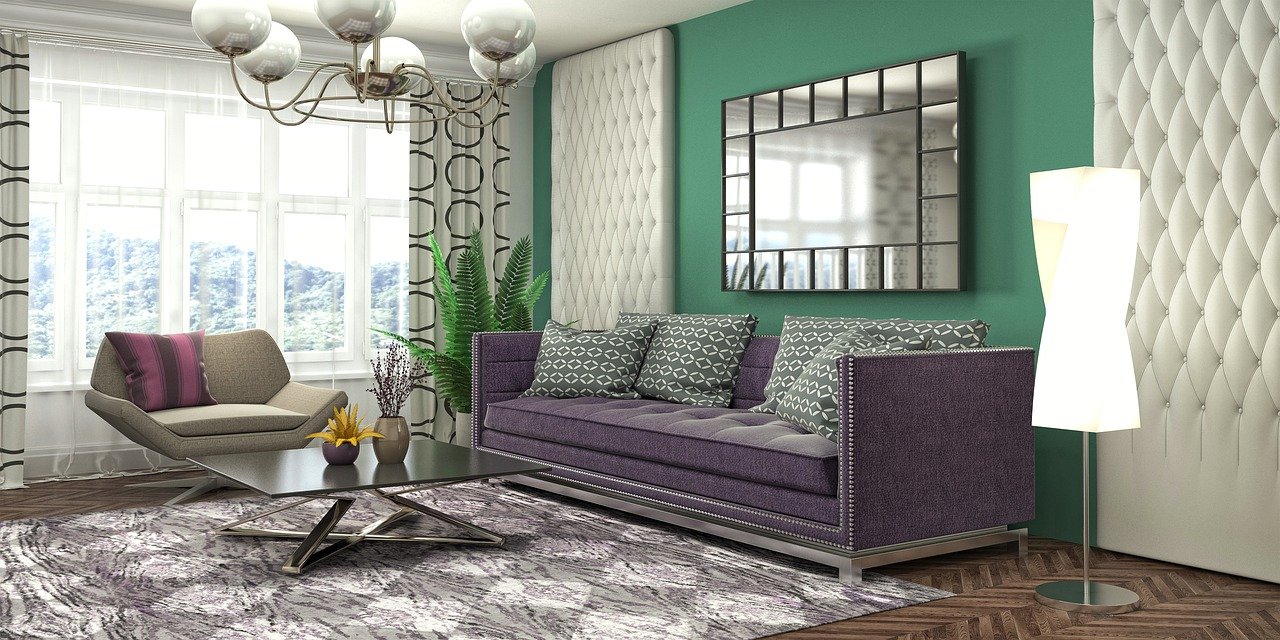
If you want to test the look before committing a whole room to it, a chevron-patterned rug and a brass-framed mirror are the two easiest entry points I found while shopping for my own place — neither requires paint or furniture replacement. Shop chevron area rugs on Amazon and shop brass-frame accent mirrors on Amazon.
Small Ways to Bring It Home Without a Renovation
None of the designers quoted above are suggesting anyone gut a kitchen for this. The pieces doing the most work are small and swappable: a jewel-toned velvet throw pillow on a neutral sofa, a brass or gold floor lamp instead of a plain black one, a mirrored side table instead of a plywood one. It’s the same trick my grandmother’s jewelry box has been doing on my dresser for years without me noticing — one glossy, geometric object can carry an entire “look” in a room that’s otherwise perfectly ordinary.
Shop emerald velvet throw pillows on Amazon if you want to test the palette on your sofa before touching anything bigger.
It’s Confidence, Not Costume
What convinced me this trend has real legs, rather than being a one-season fad tied to a museum calendar, is how consistently the designers covering it draw the same line: it’s a mood, not a theme party. Nobody quoted here is telling readers to buy a fringed flapper lamp and call it a day. The through-line is materials and finish — glossy, reflective, metallic, a little dramatic — applied with restraint to rooms that still function like normal rooms. That’s a much easier trend to actually live with than most “of the moment” aesthetics, and probably why platforms with real data behind them, like Houzz, are willing to put a number on how many homeowners are already leaning into it.
I ended up putting my grandmother’s jewelry box back on top of my dresser, in full view this time instead of tucked on a shelf. It still feels a little “much” some mornings, but I’ve stopped seeing that as a flaw. A hundred years after the style that shaped it first showed up in Paris, it turns out the thing I almost gave away was never out of date — I was just early to notice it was back.