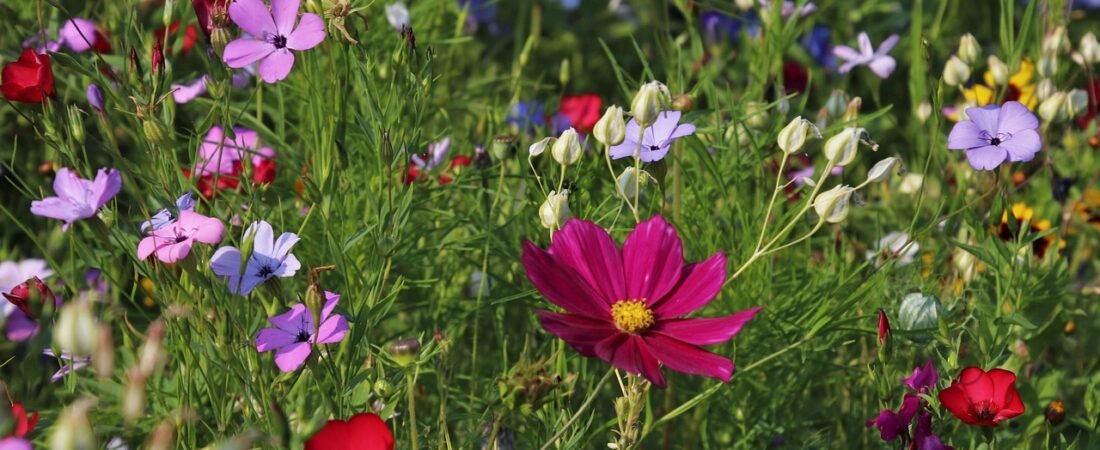
Last spring I spent an entire Saturday edging my lawn into perfectly straight lines, then watched a single bee circle the whole yard twice before giving up and flying next door, where my neighbor’s “messy” border was practically buzzing. That was the moment it clicked: the tidiest yard on the block isn’t necessarily the healthiest one. As an Amazon Associate, I earn from qualifying purchases, and a few of the small habitat upgrades below are ones I’ve since added to my own yard, one corner at a time, without turning the whole thing into a meadow overnight. If your garden currently reads as “neat but empty,” 2026 is shaping up to be the year that changes, as designers and horticulturists increasingly treat wildlife-friendly features as a baseline expectation rather than an optional add-on. Here are seven ways that shift is showing up in real backyards.
1. Splitting Your Lawn Into a “Tapestry Lawn” Instead of Mowing It All
A tapestry lawn blends low, mowing-tolerant plants — clover, self-heal, creeping thyme, and low sedges — into the turf instead of fighting to keep it a single species of grass. Garden designer Ana Sanchez-Martin, who specializes in the technique, explains that these mixed lawns are “low in maintenance and of higher ornamental and environmental value” than a standard monoculture lawn, and that mowing frequency “can be reduced by up to two-thirds compared to a regular grass lawn,” letting more plant and insect species move in as a result. You don’t need to convert the entire yard at once. Leaving even a third of it — a back strip, a slope that’s annoying to mow anyway, the area around a tree — to grow into a mixed, low sward is enough to start seeing a difference in the bees and moths passing through.
A simple starting point is overseeding a section with a low-growing mix built for reduced mowing rather than a standard fescue blend, then leaving it uncut through a full flowering cycle before the first trim: shop low-mow lawn seed mixes on Amazon.
2. Leaving the “Untidy” Corner on Purpose
Every yard has a spot nobody quite knows what to do with — behind the shed, along a back fence, under a struggling tree. The 2026 habitat-gardening approach is to stop apologizing for that corner and put it to work instead. Garden designer Helen Elks-Smith, FSGD, makes the point plainly: wildlife and insects “don’t need gardens and landscapes to have a particular design aesthetic, they don’t care whether a garden looks ‘wild’ or whether it looks ‘formal,’ what matters is habitat, food sources, and shelter.” A stacked pile of logs, prunings, and hollow plant stems left standing over winter can shelter well over a thousand insect species, from solitary bees to overwintering beetles and ladybugs, according to rewilding guidance circulating ahead of the 2026 season.
You don’t need to build anything elaborate to get the effect — a loosely stacked log pile does the job — but a ready-made wooden insect hotel is an easy way to anchor the corner and signal to visitors (and yourself) that the mess is intentional: browse insect hotels on Amazon.
3. Building Borders That Feed Wildlife Across the Whole Year, Not Just Summer
A border planted purely for a big summer show can leave birds and pollinators with nothing to eat the rest of the year. Garden designer Fiona Lamb frames the shift toward rewilded borders as a response to a harder climate to garden in: “we try to create more sustainable gardens which are better able to withstand environmental stresses,” she notes, adding that mixing plants of “varying sizes, shapes, colours, and flowering seasons” provides “year-round food and shelter for these creatures” while also helping the planting cope with weather extremes. In practice, that means layering early bulbs, mid-season perennials, and late-flowering asters or sedums into the same bed instead of one big early-summer flush, and resisting the urge to deadhead everything — seedheads left standing through fall and winter feed finches and other seed-eating birds when little else is available.
A native perennial wildflower seed mix formulated for your general region is the easiest way to add that seasonal spread without redesigning the whole border: see native wildflower mixes on Amazon.
4. Adding a Micro-Pond or Rain Garden Instead of a Bigger Water Feature
You don’t need a koi pond to give a yard real water habitat. A shallow, ground-level dish or a small preformed pond tucked into a border can support frogs, dragonflies, and birds that need somewhere to drink and bathe, and a rain garden — a shallow, planted depression that catches runoff from a roof or driveway — does double duty by slowing stormwater instead of sending it straight to a drain. Master gardener Katy Willis, writing for House Digest ahead of the 2026 season, sums up where the broader gardening conversation is heading: “the focus is on wildlife, conservation, whimsy, and vibrant color,” with rain gardens and micro-ponds named specifically among the trends gaining traction for exactly that reason.
A small preformed pond liner is the least intimidating way to try this on a weekend, even in a modest-sized yard: check preformed pond liners on Amazon.
5. Choosing a Native Tree for Shade Instead of an Ornamental One
When it’s time to replace a tree or add one, the 2026 habitat-first approach favors a native species over a purely ornamental import — something that hosts local caterpillars and insects rather than sitting in the landscape as decoration alone. Native and multi-stem trees are being singled out in 2026 gardening forecasts specifically for combining dappled shade, cooling effects, and support for local wildlife, unlike many fast-growing ornamental varieties that offer little food value to birds or insects even when they flower well. A native oak, serviceberry, or dogwood, chosen for your specific region, does more ecological work over a decade than several ornamental trees combined, largely because local wildlife evolved alongside those species and can actually use them.
If you’re planting bare-root or in a container this fall, a tree-planting kit with root barrier fabric and slow-release fertilizer suited to natives helps a young tree establish faster: browse tree-planting kits on Amazon.
6. Swapping Bright Floodlights for Warm, Motion-Sensor Lighting
Constant bright garden lighting disorients moths, bats, and other nocturnal pollinators, which is part of why 2026 forecasts point toward motion-activated, warm-toned lighting instead of always-on floodlights. Trend trackers at British Garden Centres note that “motion sensor lighting is transforming outdoor spaces, making them usable after dark and enhancing security around homes while illuminating pathways and garden features” — the light comes on when it’s actually needed rather than running all night. For a habitat-minded yard, pairing motion sensors with warm (2700K or lower) bulbs instead of cool white ones is the detail that matters most, since warm light is far less disruptive to insects and the bats and birds that feed on them.
Solar-powered, motion-triggered path lights in a warm white tone are an easy weekend upgrade that needs no wiring: shop warm-white motion sensor lights on Amazon.
7. Letting the Whole Yard Read as “Of Nature,” Not “Designed”
The common thread running through every trend above is a shift in what a “finished” garden is supposed to look like. Garden designer Ann-Marie Powell puts it directly: “I’d say the trend for this year is the immersive, natural, wildlife garden,” adding that “people want gardens that look like they are ‘of nature’ rather than the more obviously designed spaces.” That doesn’t mean abandoning structure — paths, seating, and a few crisp edges still make a yard usable — but it does mean the plantings themselves are allowed to lean, self-seed, and overlap instead of standing at attention in isolated rows.
Bird nest boxes are a low-effort, high-payoff way to signal that shift and give the wildlife you’re attracting somewhere to actually raise young next spring: see bird nest boxes on Amazon.
None of this requires ripping out an existing garden and starting over — that’s the whole point. Pick the one change that fits the corner you already avoid mowing, dig one small pond-sized hole, or swap a single floodlight for a motion sensor this month, and let the rest follow next season. The yards that end up genuinely full of birds, bees, and frogs by next summer aren’t the ones that redesigned everything at once; they’re the ones that stopped tidying away every sign that something wild was allowed to live there.