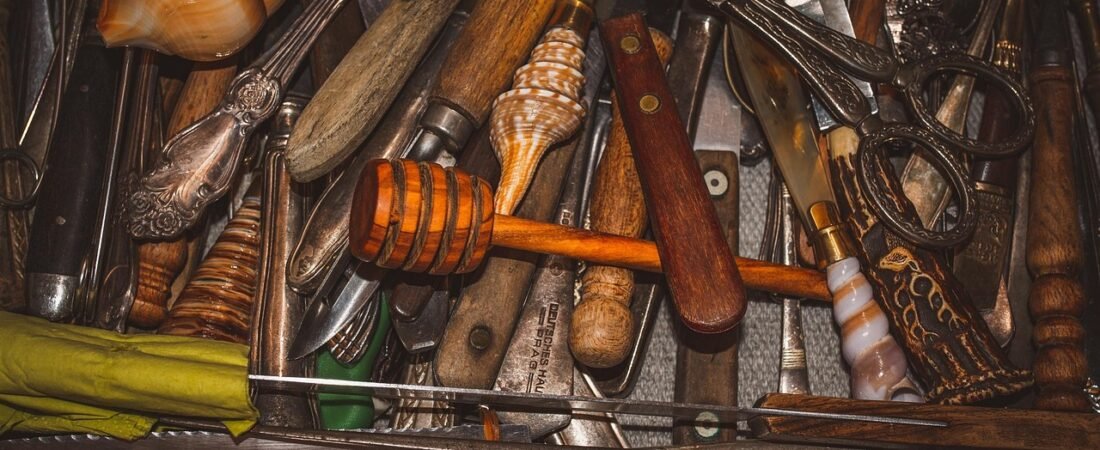
My junk drawer has been “on my list” since March. Every few weeks I open it, wince, and close it again, defeated by the sheer, formless size of the task: organize the drawer. Then a few weeks ago I watched a video of someone doing something called the Domino Method, and instead of “organize the drawer,” the instruction was absurdly small — take out the trash, empty one shelf, live with it for a day. I did that one tiny thing on a Tuesday night. By Thursday I’d done three more. My junk drawer is, as of this week, a solved problem. It turns out I didn’t need more willpower. I needed a name for the process.
The Trend: Decluttering Now Comes With a Name Tag
If you’ve scrolled home content on TikTok or Instagram this year, you’ve probably noticed that nobody just “declutters” anymore. They do the Domino Method. The Sunday Butterfly Method. The One Tote, One Day Method. The 1-3-5 Method. Home and lifestyle editors have taken notice too — Homes & Gardens went as far as compiling and testing what it calls a library of 127 different named decluttering methods, sorted by who they’re for: procrastinators, sentimental hoarders, neurodivergent brains, people who only have fifteen minutes, people who can’t finish what they start.
That number alone tells you something real is happening. This isn’t a single viral hack that will fade by next season. It’s a genre. Generic advice like “declutter your whole house this weekend” has quietly been replaced by dozens of specific, branded, testable systems, each one solving a narrower, more honest version of the actual problem — not “I have too much stuff,” but “I can’t start,” or “I start and never finish,” or “my brain doesn’t work in straight lines.”
Meet the Methods Everyone’s Actually Trying
The Domino Method is built entirely around momentum. Cathy Orr, co-founder of The Uncluttered Life and a certified KonMari consultant, explained it to Homes & Gardens this way: “It’s a way to pace yourself and have a few good ‘wins’ at the beginning. This encourages people to continue to the bigger and harder piles, while getting an idea of how much time and energy decluttering takes. It also helps them experience immediate improvement in their space.” Her starting point is almost insultingly small — “do one little thing, such as take out the trash and declutter one drawer or cabinet, the first day. Live with it.” Only once that’s finished do you move to something slightly harder. The point isn’t the drawer. The point is proving to yourself that you can finish something, which is exactly what I stumbled into with mine.
The Sunday Butterfly Method takes the opposite approach to structure — it has almost none. It was named by Lydia Hayman, Kitchen and Appliance Editor at Homes & Gardens, who described developing it for her own “butterfly brain”: “I have been using what I call Butterfly Decluttering, because my mom and I have butterfly brains and always float from one thing to the next.” Rather than fighting that tendency, the method works with it. “I simply walk around my house doing whichever task I notice and act on it in the moment, without putting pressure on myself to do it a certain way, or in any order,” Hayman said. She pairs it with an audiobook so her hands stay busy while her mind is free to wander. Rebecca Jo-Rushdy, a KonMari Master Consultant and founder of Spark Joy and Flow, said the name resonated with her instantly: “I love the Sunday Butterfly name as I’m neurodivergent, and totally relate to what Lydia has described. My husband recently teased me that it’s not multitasking, it’s rapid switching!”

Then there’s the more brute-force crowd. The One Tote, One Day Method, popularized on Real Simple, strips things down even further: grab a tote bag, pick a room, and fill the tote as fast as you can with anything that doesn’t belong there — trash, donations, or things that live in a different room. Empty the tote, repeat tomorrow, different room. And the 1-3-5 Method, which Homes & Gardens tested ahead of hosting guests, works like a daily to-do list rule applied to clutter: pick one big task, three medium ones, and five small ones, so the day never feels like an open-ended chore with no finish line.
Why Professional Organizers Are Split on the Trend
Not every expert is thrilled that decluttering has turned into a scroll-and-pick menu. Samantha Pregenzer, founder of Simply Organized, pushed back on the whole premise in a recent interview, arguing that packaging organization into trendy, one-size-fits-all frameworks oversimplifies what’s actually a personal process: “Real organizing is slower, more customized, and less dramatic than trends suggest.” Her concern isn’t with any single method — it’s with treating a method as a substitute for actually understanding your own habits, your own space, and why the clutter built up in the first place.
There’s also a deeper, more emotional critique buried in a lot of this content: the fear that decluttering means erasing something meaningful. Professional organizer Rachel Rosenthal addressed that directly, reframing what letting go actually means: “You’re not erasing memories by decluttering. It’s about creating space for memories that matter now.” That distinction — between deleting the past and making room for the present — comes up constantly in the comments sections under these videos, which is probably why it resonates. The named methods work as entry points, not because the name itself is magic, but because they lower the emotional and logistical barrier to just starting.

So Which One Should You Actually Try?
The honest answer, according to the organizers above, is: whichever one matches the actual reason you’re stuck, not the one with the most views. If you can’t finish what you start, the Domino Method’s tiny-first-win structure is designed exactly for that. If your brain resists linear to-do lists and you tend to bounce between rooms anyway, the Sunday Butterfly Method stops fighting that instinct and uses it. If you’re facing a single overwhelming space and just need momentum today, One Tote, One Day gives you a hard, physical stopping point — an empty tote — instead of an open-ended goal. And if you thrive on structure but panic at big projects, 1-3-5 turns “declutter the house” into a manageable daily quota.
What none of them require is new storage products, new bins, or a redesigned closet system. That’s arguably the real reason this trend has staying power while so many organizing fads haven’t: it’s free, it’s fast to test, and if a method doesn’t click after a week, you just try the next one. Pregenzer’s caution is worth holding onto here, too — a named method is a starting ritual, not a finished system. The real organizing still happens after the momentum kicks in, when you decide what actually stays.
My drawer, for the record, didn’t get organized because I found the perfect bin insert or a genius labeling system. It got organized because someone gave the tiny, boring first step a name, and a name was somehow enough to get me to do it. I don’t know if I’m a Domino person permanently, or if next month I’ll be walking around my apartment doing the Sunday Butterfly instead, following whatever mess catches my eye. That’s sort of the point — the method isn’t the goal. Finishing the drawer was.