You reorganize the living room shelves, tuck everything into identical white bins, and somehow the room still ends up looking like a doctor’s office waiting area. If that sounds familiar, there’s a reason: home organization in 2026 has turned its back on the shallow minimalism that dominated the last decade. Two real trends are driving the shift — cluttercore, which champions displaying your collections and favorite objects in a curated way instead of hiding them behind closed doors, and cubicle chic, which tackles the opposite problem, the home office corner that never quite fits anywhere, with furniture that folds, slides, or disappears once the workday is over. Both trends start from the same idea: organizing no longer means hiding everything behind matching containers, it means building a system that actually reflects who lives there. This article includes links to products researched on Amazon, so here’s the required disclosure: As an Amazon Associate, I earn from qualifying purchases. If you buy through one of these links, we earn a small commission at no extra cost to you.
What Cluttercore and Cubicle Chic Actually Are
Cluttercore emerged as a reaction to minimalism gone cliché: empty shelves, white walls, zero personality. The logic is simple — instead of stashing vinyl records, books, plants, and travel souvenirs inside opaque boxes, you build a thoughtful display with layers, colors, and textures that tell a story. It’s not actual clutter, it’s curated clutter. Cubicle chic, on the other hand, solves a more practical problem: now that the home office has become a permanent fixture in millions of households, nobody wants a work corner sitting in the middle of the living room all day, every day. The answer is disguised furniture — desks that fold flat against the wall, sliding doors that close off a work nook, carts that roll out from under the table and back into the closet. Together, the two trends shift the organizing question from hide everything to choose what to show and what to hide.
7 Amazon Products That Bring Both Trends Together
1. Glass-Front Cabinet for Displaying Collections
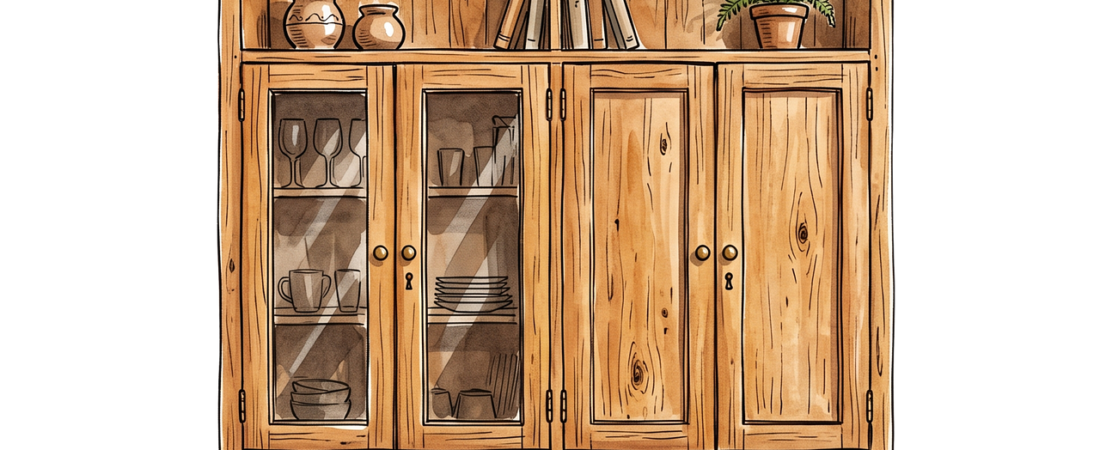
Everyone has that cardboard box in the back of the closet full of things too good to toss and too specific to leave out — family china, vinyl records, miniatures, beautifully bound books. Cluttercore fixes this by swapping the box for a piece of furniture with glass doors: your items stay protected from dust but remain visible, becoming part of the decor instead of hiding away. It’s the kind of piece that turns something stored into something displayed, without tipping into visual chaos, because the glass creates a natural frame for whatever arrangement you put inside.
→ Shop Glass-Front Display Cabinet on Amazon: View on Amazon →
2. Tiered Riser Shelf for Styling Surfaces
A flat shelf puts everything on the same line, so small objects get lost behind bigger ones and the countertop turns into a jumble with no visual hierarchy. A tiered riser fixes that by creating levels: you can group candles, small plants, picture frames, and ceramics by height, the exact technique interior stylists use to build those shelf arrangements that look intentional instead of accidental. It’s a small piece, but it’s the kind of detail that separates a well-done cluttercore shelf from an unplanned mess.
→ Shop Tiered Display Shelf Riser on Amazon: View on Amazon →
3. Wall-Mounted Fold-Down Desk
If your home office right now is a desk permanently claiming a corner of the living room, even on weekends when nobody’s working, you already know the problem cubicle chic is trying to solve. A wall-mounted fold-down desk becomes practically invisible when closed — it turns into a flat panel, sometimes with a built-in frame or mirror — and opens in seconds when it’s time to work. It’s the centerpiece of the trend: the office exists when you need it and disappears when you don’t, without requiring an entire room dedicated to it.
→ Shop Wall-Mounted Fold-Down Desk on Amazon: View on Amazon →

4. Sliding Pocket Door Hardware Kit
Not every home has room for a standard door, which needs open floor space to swing. A sliding pocket door kit tucks into the wall itself or rides an exterior track, and it’s exactly the kind of solution cubicle chic uses to close off a work nook, an open pantry, or a sewing corner without sacrificing square footage. You can turn practically any recessed space — under the stairs, a gap between two rooms — into something that stays open day to day and closes when company comes over, with no heavy structural remodel involved.
→ Shop Sliding Pocket Door Hardware Kit on Amazon: View on Amazon →
5. Rolling Storage Cart with Drawers
The fold-down desk solves your work surface, but what about the stuff — cables, notebooks, chargers, headphones? A rolling cart with drawers is the natural companion to cubicle chic: it holds everything that normally ends up scattered across the desk, and at the end of the day you simply roll it into a closet, behind the couch, or under the stairs. Because it’s on wheels, it also works in any room — it becomes a workstation in the living room in the morning and rolls back to the bedroom at night, without turning into a fixed piece of furniture hogging space.
→ Shop Rolling Storage Cart with Drawers on Amazon: View on Amazon →
6. Cable Management Box
No desk hidden behind a door or folded against the wall looks good if there’s a tangle of charger cords, router cables, and a power strip behind it. A cable management box handles the detail that tends to wreck the aesthetic of both trends at once: it gathers cords and adapters inside a closed compartment, so both the work corner and the electronics shelf end up looking clean, without having to zip-tie every single cable by hand.
→ Shop Cable Management Box on Amazon: View on Amazon →
7. Wooden Compartment Tray Organizer
Every loose item — keys, glasses, rings, cards — needs a home, but tossing all of it into a closed drawer is exactly the habit cluttercore wants to break. A wooden tray with compartments sits on the entryway console, the living room table, or the bedroom dresser and gives everyday items a fixed spot without hiding them — they stay visible, just organized by category instead of scattered. It’s the practical side of curation: nothing piled up at random, but nothing locked away out of sight either.
→ Shop Wooden Compartment Tray Organizer on Amazon: View on Amazon →

Where to Start
You don’t need to remodel your entire house to apply both trends at once. The most realistic approach is to pick one piece from each side: something that displays an item you’re currently hiding in a box (cluttercore), and something that hides an item currently sitting out in the open without needing to be (cubicle chic). Start with the room that bothers you most — usually the living room, where both tensions, showing off collections and hiding work, show up at the same time — and let the rest of the house follow the same logic gradually. The idea behind 2026 isn’t organizing everything the same way, it’s organizing each thing the way it deserves: what you love, on display; what gets in the way, out of sight.