
For two years, my “home gym” was a treadmill facing a bare cinderblock wall in the corner of our unfinished basement, next to a water heater that clanked every time it kicked on. It worked, technically. But I dreaded going down there more than I dreaded the actual workout. As an Amazon Associate, Every Corner earns from qualifying purchases made through the Amazon links below, at no extra cost to you — full transparency before we get into it, because a few of these products are genuinely what turned my basement corner into a room I look forward to using. This year I finally redid the space, and while researching it I noticed the same handful of changes coming up again and again in what designers who actually build these rooms for clients are recommending for 2026. None of it required knocking down walls. Here’s what’s changing.
Warm, House-Like Flooring Replaces Black Rubber
The single biggest shift designers point to is flooring, and it’s the one thing most of us default to getting wrong. The team at DK Studio, an Austin-based firm that designs custom home gyms, puts it simply: “the fix is to match your gym flooring to the rest of your house and go with warmer stuff like polished concrete, tile, terrazzo, or cork instead of the standard black rubber.” Standard black rubber tile reads as commercial the second you walk in, no matter how nice the equipment is. Swapping it for interlocking cork flooring tiles keeps the shock absorption a workout room needs while making the space feel like it belongs in your house instead of a strip-mall gym.
A Mirror Wall Big Enough to Actually Use
Mirrors aren’t optional in a home gym designed for real training, but designers say most people install one far too small. “We always recommend going for the largest mirror you can afford,” says interior designer Kelly Hoppen, who also stresses being realistic about the room’s footprint from the start: “when drawing up the floor plan, be practical about the size of the room you have.” A wall-length mirror does double duty — it lets you actually check your form during lifts, and it makes a small converted room feel noticeably larger. A full-length wall mirror mounted edge to edge is a weekend project, not a renovation.

The Room Gets Zoned Like a Boutique Studio
Instead of one open room with equipment scattered around the perimeter, designers are laying out home gyms in distinct zones, the way a boutique fitness studio would. “Functionality is key for your home gym ideas, spaces should be zoned,” says London-based designer Katharine Pooley, who separates cardio, strength, and stretching areas even in modest-sized rooms rather than letting everything blur together. In practice that can be as simple as a floor rug marking off a mat zone, a wall rack containing the free weights, and a cleared strip for cardio equipment, so the room reads as organized instead of cluttered no matter how much gear is in it.
Lighting and Sound Get as Much Attention as the Equipment
The atmosphere of the room is getting as much design attention as the equipment inside it. Katharine Pooley says “it’s about the music, the lighting, the atmosphere; the same is said for your at-home” workout space, and Joanna Lavén, founder of Studio Lawahl, echoes it with specifics: she recommends “functional lighting, including adjustable fixtures that brighten or soften as needed,” paired with sound control, since “to ensure a peaceful environment, choose a high-quality gym mat that dampens sound.” Between a dimmable smart bulb and a proper sound-dampening exercise mat, this is one of the cheapest upgrades on the list — and the one that changes how the room actually feels to be in.
Saunas and Cold Plunges Turn Gyms Into Recovery Rooms
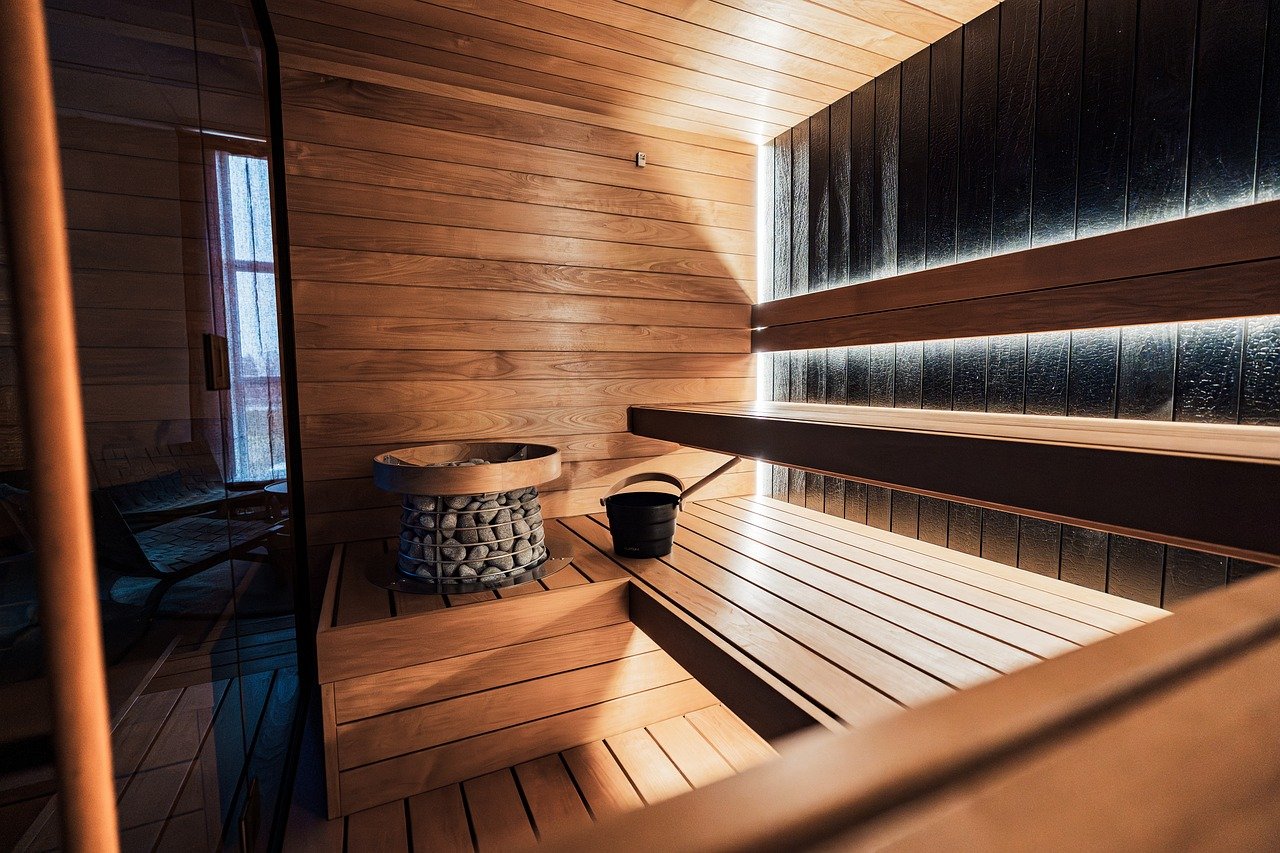
Home gyms are quietly expanding into recovery spaces, not just workout spaces. “Saunas are being added to home gyms, becoming the number one wellness request for our firm as of late,” says Theresa Ory, founder of Theresa Ory Interiors in Atlanta. It’s a bigger investment than most items on this list, but it reflects a real shift in how people are using the room: not just for the 45-minute workout, but for the 10 minutes before and after it too. If a full sauna build isn’t in the budget, even a portable infrared sauna blanket tucked in a corner captures the same idea on a much smaller scale.
Rich Wood Accents Soften All That Hardware
Metal equipment, mirrors, and rubber flooring can add up to a cold, clinical-feeling room fast, which is why designers keep reaching for wood to balance it out. Joanna Lavén advises clients to “incorporate rich wood accents throughout the room – on cabinetry, trim, or equipment,” treating it as the warm counterweight to all the hard surfaces a gym requires. A simple wood-toned weight rack or wood-trimmed shelving does more visual work than you’d expect, especially against a black-and-mirror backdrop.
Gyms Move Into Whatever Room Is Sitting Unused
Not every home gym trend is about spending more — several designers are pointing out that the room itself doesn’t need to be purpose-built. Designer Leanne Ford turned an old tool shed into her workout space: “I went ahead and made myself a Yoga Studio in our old Tool Shed, because why not!?” The logic applies just as well to a spare closet, an underused dining room, or a corner of the garage. The room matters less than treating it with the same intention as any other space in the house — good flooring, good light, and gear that’s stored rather than piled.

What struck me putting this list together is how little of it is actually about buying more equipment. My basement corner didn’t need a bigger squat rack — it needed flooring that didn’t feel like a parking garage, a mirror I could actually see myself in, and a light that wasn’t a single bare bulb overhead. Pick two or three of these that fit the room you already have, and the workout stays exactly the same, but showing up for it stops feeling like a chore.